




The competitive landscape in retail banking is changing in ways that conventional measures of market share do not fully capture. Banks retain advantages in balance sheet size, deposits, lending capacity and regulatory infrastructure, but financial platforms are establishing a different form of competitive power through the frequency, reach and depth of customer engagement.
Across some of the world's largest digital finance markets, individual platforms now engage more than half of the adult population every month. Several have established their market positions without offering the full range of traditional retail banking products. Instead, they built customer relationships through a narrower set of high-frequency activities, particularly payments, money transfers and credit cards and are now leveraging this engagement to expand into higher-value services, including lending, savings and wealth management.
Financial engagement becomes a measure of market power
Measuring monthly active users (MAUs) as a proportion of a country's adult population shows how deeply financial platforms are embedded in everyday economic activity, extending beyond payments and e-commerce. High penetration rates reflect strong customer engagement, growing payments activity and an increasing ability to monetise customer relationships through banking and investment services. They also indicate how these platforms are becoming the primary interface for customers' financial decisions, even when they are not their primary deposit-taking institution.
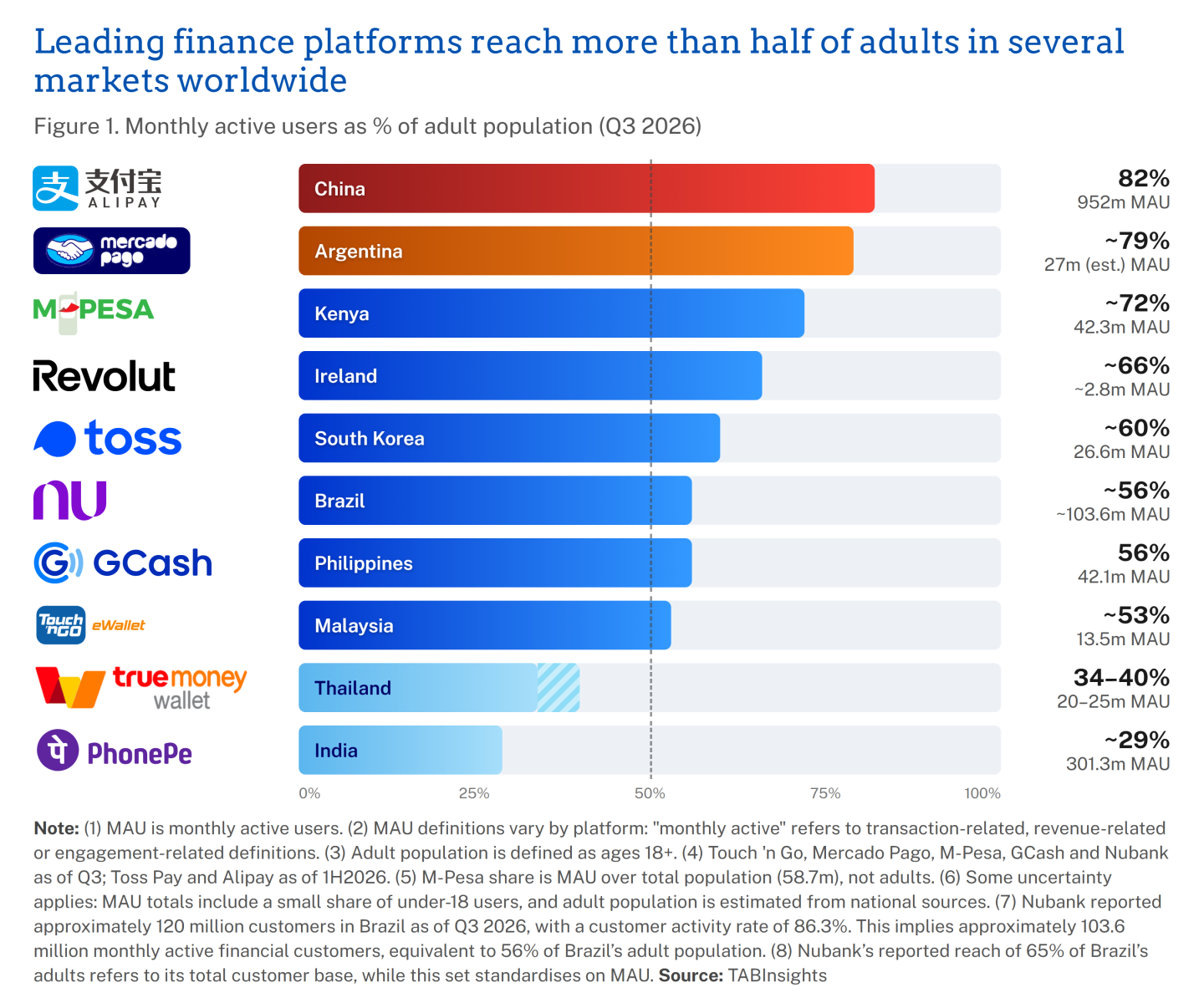
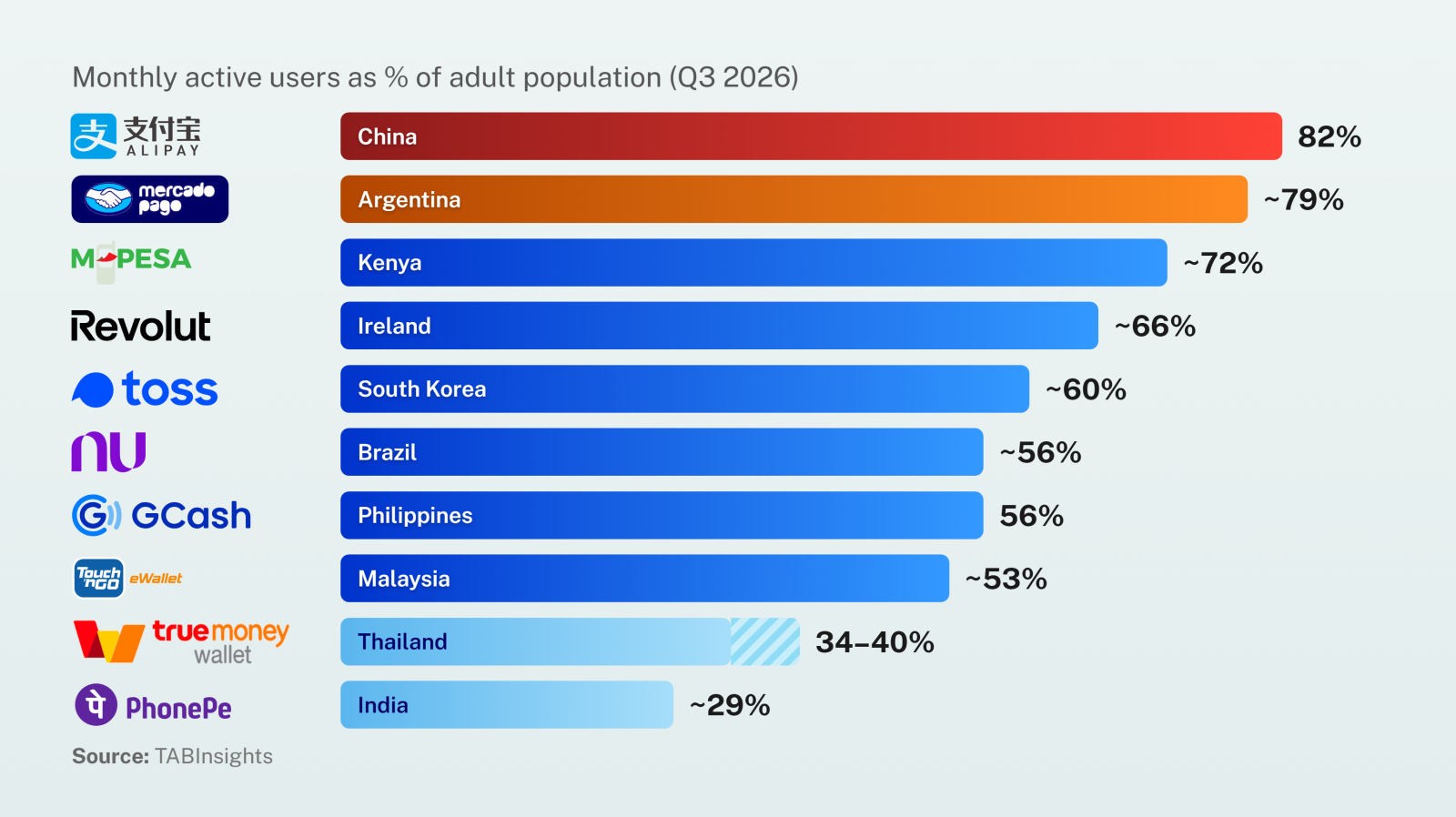
Alipay and Mercado Pago illustrate the sheer scale of this reach, with MAUs equivalent to close to 80% or more of their respective adult populations in China and Argentina. Both are ranked among the world’s leading platforms in the TABInsights World’s Best Financial Platforms 2026.
Alipay, operated by Ant Group, has evolved over two decades from a simple payment tool into China's leading financial super-app, reaching roughly 952 million MAUs, equivalent to 82% of China's adult population. Beyond digital payments, it connects users to over 2,000 financial institutions, offering consumer credit, wealth management, insurance and government services through a single platform.
Although users typically hold their funds in traditional bank accounts, Alipay captured a growing share of the customer relationship. Customers increasingly use the platform to research, compare, select and manage most financial products, influencing where they spend, borrow, save and invest. Its competitive strength lies less in attracting deposits than in controlling the interface through which customers access financial services.
This engagement is reflected in time spent on the platform. According to China-based research firms QuestMobile and iResearch, Alipay users spend approximately 16–19 minutes a day in the app across payments, services and financial management, compared with an average of 3–4 minutes of active banking transactions on traditional Chinese bank apps. Industry estimates put Alipay's transaction frequency at two to three payments per active user daily, although Ant Group does not officially disclose this metric.
Mercado Pago, the digital wallet of Mercado Libre, Latin America’s largest e-commerce and financial technology ecosystem, is expanding into a broader financial platform. It reached 93 million MAUs in the third quarter of 2026, up 29% year-over-year, while transaction volumes rose 41% to 5.7 billion, according to Mercado Libre's third quarter 2026 financial results.
The platform is also expanding beyond payments into lending and wealth management. Assets under management grew 67% year-on-year to $25 billion, while its total credit portfolio increased 62% to $17.9 billion. Credit cards accounted for $8.5 billion of the portfolio, up 76%, with 2.9 million new cards issued during the quarter.
Nubank illustrates how high customer engagement can develop into a broader banking franchise. Starting with credit cards, it has expanded into deposits, lending, investments and other financial services. In November 2026, it obtained a banking licence through its acquisition of Banco Porto Real de Investimentos. The platform now reaches 56% of Brazil's adult population.
Its average monthly revenue per active customer (MRPAC) increased from $3.60 in 2020 to $9.6 in 2023 to $13.30 in 2025, according to its annual reports. Nubank also achieved full year profitability in 2023, 10 years after launching in 2013.
South Korea’s Toss shows how financial platforms can compete with established banks through customer engagement rather than balance sheet strength. In the third quarter of 2026, 49% of surveyed Korean financial consumers said they regularly used Toss or considered it essential to their daily lives, ahead of KakaoBank at 42%, Naver Pay at 40%, and Kakao Pay and KB Star Banking at 39% each, according to ConsumerInsight. By June 2026, Toss had reached 26.6 million monthly active users, who spent an average of 155 minutes on the platform each month, according to local media reports.
Launched in 2015 as a money transfer service, Toss has expanded into payments, credit management, financial product distribution, securities and digital banking. Unlike Naver and Kakao, which built their payment businesses around e-commerce and messaging ecosystems respectively, Toss has centred its expansion on financial services. Its move into physical merchant payments is intended to capture more everyday consumer spending
From owning the transaction to owning the conversation
Competitive advantage in banking is shifting from ownership of financial products and distribution channels towards control of the customer relationship conversation and influence over financial decisions. The strength of these platforms extends beyond transaction volumes. By analysing millions of customer conversations and everyday financial interactions, they can identify unmet needs, anticipate demand and develop new products and services.
Revolut, for example, is developing proprietary AI models using these data to better understand customer behaviour and personalise financial services. As its founder and CEO Nik Storonsky said in October 2026: “With 30 to 40 million transactions taking place every day on Revolut, we have a unique dataset to build on.” Advances in technology and AI infrastructure are enabling platforms to identify financial needs as they arise and bring relevant products to market faster than traditional banks.
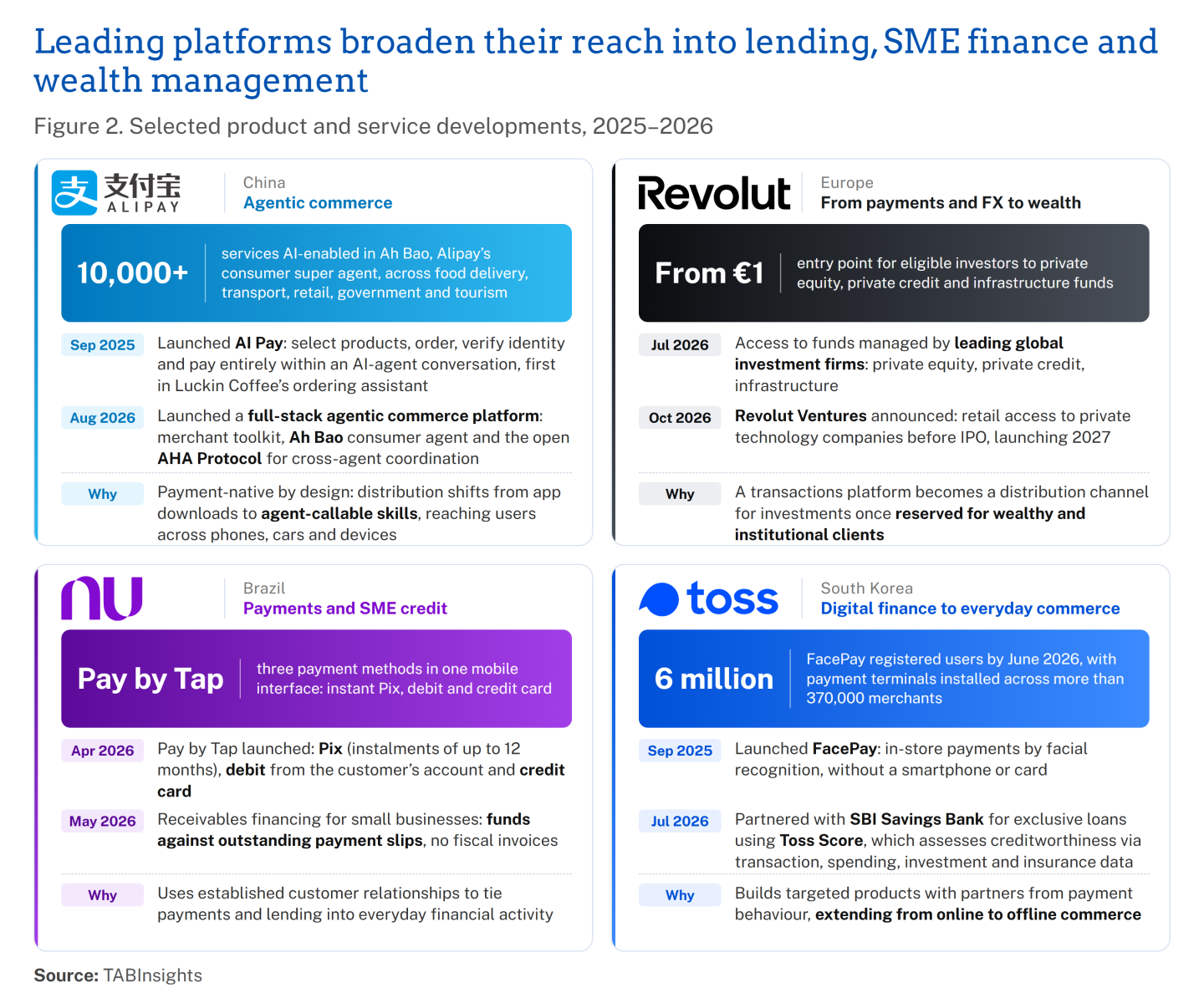
AI and agent platforms such as ChatGPT and Perplexity could accelerate this shift. Traditional financial platforms that already command everyday financial interactions are well positioned to become the interfaces through which customers seek advice, compare financial products and increasingly delegate financial decisions. As a result, the institution executing a transaction may no longer be the one influencing it.
The contest for primary financial relationships
High customer engagement does not necessarily translate into deposit dominance, profitability or primary banking status. Revolut, for example, claims to hold 10% to 20% of salary accounts across most of its markets. For Nubank, 23% of respondents in Brazil identified it as their main financial institution, ahead of Itaú at 13% and Banco do Brasil at 11%, according to a November 2026 Okiar Intelligence survey. Nubank's 2025 annual report indicates that it holds a 3.5% share of individual deposits and retail investor assets.
However, high customer engagement provides a strong foundation for platforms to capture a greater share of customers’ financial assets and borrowing needs. The competitive threat to traditional banks is therefore not simply that fintechs will become banks. It is that platforms can progressively capture the most valuable elements of the customer relationship while relying on banks for funding, balance sheet capacity and regulated financial services.
For banks, market share in deposits and lending remains important, but it is increasingly insufficient as a measure of long-term competitive strength. The emerging contest is over who becomes the customer's first point of contact for financial decisions. Banks may continue to hold the money, but financial platforms including emerging AI platforms, that own the conversation will increasingly influence where that money goes.
Subscribe for regular insights.










 Google
 LinkedIn