



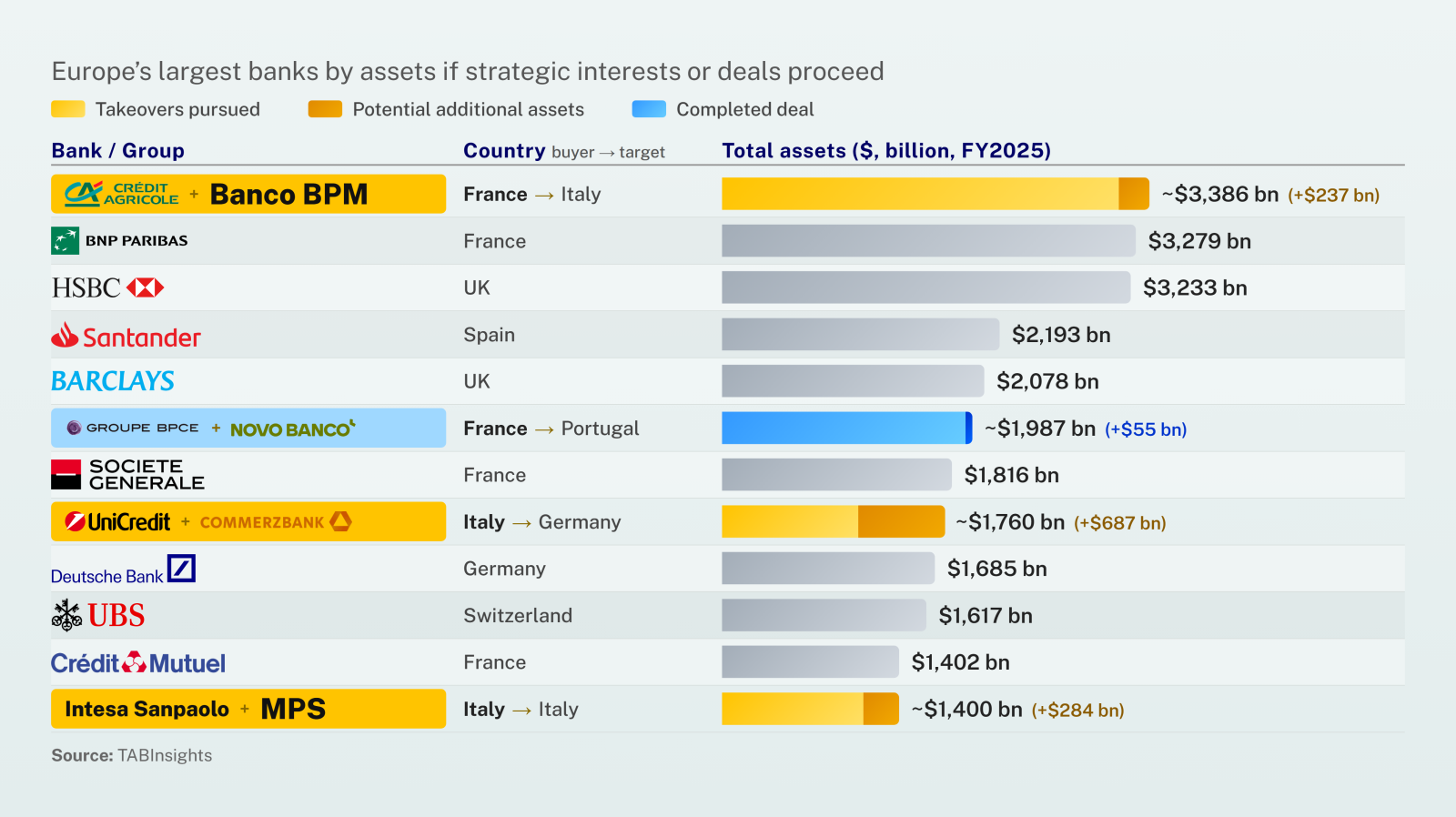

Cross-border M&As in European banking, account for only about 20-25% of all banking capital market deals in the first half of 2026, yet activity is gaining momentum through high-profile acquisitions, strategic shareholdings and contested takeover attempts. France's BPCE completed its EUR 6.7 billion ($7.4 billion) acquisition of Portugal's novobanco in April 2026, making Portugal its second domestic retail banking market. BPCE is also building a broader European financial services presence through a 7% stake in Spain's Banco Sabadell, with scope to increase it to 9.9%, and a proposed acquisition of Portuguese insurer GamaLife that would extend its bancassurance model. Together, these moves illustrate how banks are combining outright acquisitions with minority investments and insurance expansion to build regional franchises.
The proposed UniCredit–Commerzbank merger is arguably the most consequential test of Europe's ambition to create genuinely pan-European banking champions. UniCredit's pursuit of Germany's second-largest listed commercial bank challenges the traditional national boundaries of European banking.
The two cases also illustrate two different routes to European banking integration: negotiated acquisitions that create new domestic franchises and contested takeovers, such as UniCredit's pursuit of Commerzbank, that test the limits of national control.
Domestic consolidation triggers wider market restructuring
Italy has become a focal point of European banking consolidation, where one takeover could trigger a wider restructuring of the sector. Intesa Sanpaolo, Italy's largest bank, is seeking to acquire Monte dei Paschi di Siena (MPS), the country's third-largest lender, creating a group with approximately EUR 1.2 trillion ($1.4 trillion) in combined assets and 27 million customers.
MPS had already expanded beyond traditional commercial banking through its acquisition of Mediobanca in 2025, gaining an established investment banking and wealth management franchise, as well as an indirect stake in Generali, Italy's largest insurer. In response to Intesa Sanpaolo's takeover bid, MPS launched separate bids in August 2026 to acquire Banco BPM, another major Italian lender, and Banca Generali, the wealth management subsidiary of insurer Generali, in an effort to preserve its independence. The strategy would have broadened MPS's banking and wealth management businesses while providing an alternative to Intesa's offer, but shareholders rejected the proposal, removing a major obstacle to Intesa's takeover, which now appears increasingly likely to proceed. This has also reopened opportunities for France's Crédit Agricole, which owns 29.6% of Banco BPM and has previously expressed interest in in merging the lender with its existing Italian banking operations.
The two banks have already established partnerships across consumer finance and insurance. Crédit Agricole Consumer Finance holds a 61% stake in Agos, their joint consumer lending business, while Banco BPM owns the remaining 39%. Their collaboration also extends to non-life insurance. Crédit Agricole’s formal proposal to merge Banco BPM with its Italian operations marks the culmination of a nearly two-decade strategy of incremental expansion in Italy. The transaction would create Italy’s third-largest banking group and strengthen Credit Agricole’s position among Europe’s largest banking groups, alongside with BNP Paribas. Banco BPM CEO Giuseppe Castagna also indicated during the bank’s third-quarter earnings call on 5 November that he would consider a potential merger with Crédit Agricole, provided the terms were acceptable to shareholders.
However, under Italy's golden power legislation, the government can impose conditions on, or block, transactions involving strategic assets, including financial institutions. Reuters reported that Crédit Agricole had offered assurances concerning Italian savings invested in government bonds. One particular concern is Anima, the asset manager controlled by Banco BPM and a significant investor in Italian sovereign debt. The outcome could therefore reshape Italy’s banking landscape, with Intesa, UniCredit and Crédit Agricole positioning themselves for a new competitive order.
Banking consolidation reshapes control across financial services
The impact of European banking consolidation is extending beyond traditional commercial banks, lending and deposits into insurance, wealth management and asset management, where ownership structures and distribution relationships are becoming increasingly important strategic assets.
MPS's acquisition of Mediobanca in 2025 gave it an indirect 13.35% stake in Generali, Italy's largest insurer, extending its influence beyond banking. But if Intesa Sanpaolo's proposed takeover of MPS succeeds, the stake could become part of the enlarged group, potentially altering Generali's shareholder dynamics and raising questions about its governance and independence. This could also affect the balance among other influential investors, including Delfin, Caltagirone, Benetton and UniCredit.
The implications extend to insurance distribution. AXA expects that its bancassurance agreement with MPS, due to expire around 2027, may not be renewed, potentially opening opportunities for competing insurers. Together, these developments illustrate how banking consolidation can reshape both ownership of strategic financial assets and access to customers through established distribution partnerships.
The strategic value of banking acquisitions increasingly extends beyond the balance sheet. Control over insurance holdings, investment capabilities and customer distribution networks can be as consequential as acquiring deposits, lending portfolios or branches. Consolidation is therefore reshaping not only who owns banks, but also who controls access to customers and the wider financial services value chain.
Europe's cross-border consolidation cycle is entering a new phase, advancing through multiple channels, including cross-border acquisitions, domestic takeovers, strategic shareholdings and the reorganisation of financial-services relationships. The defining competitive advantage will be not be merely greater scale, but the ability to translate ownership and market position into stronger control over the wider financial-services value chain.
View the full ranking for Europe’s largest banks in the TAB Global 1000 World’s Largest Banks.









 Google
 LinkedIn