



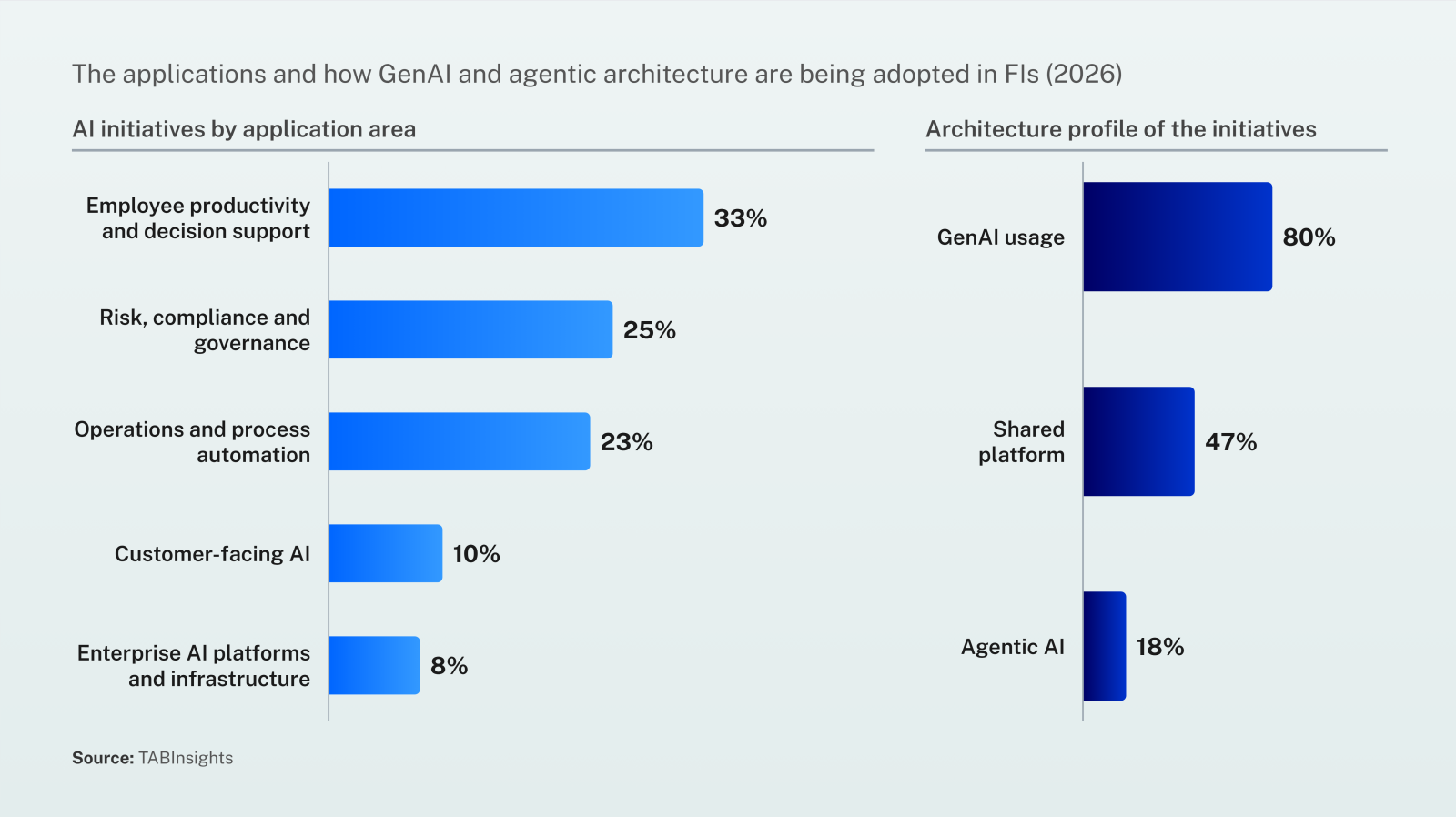

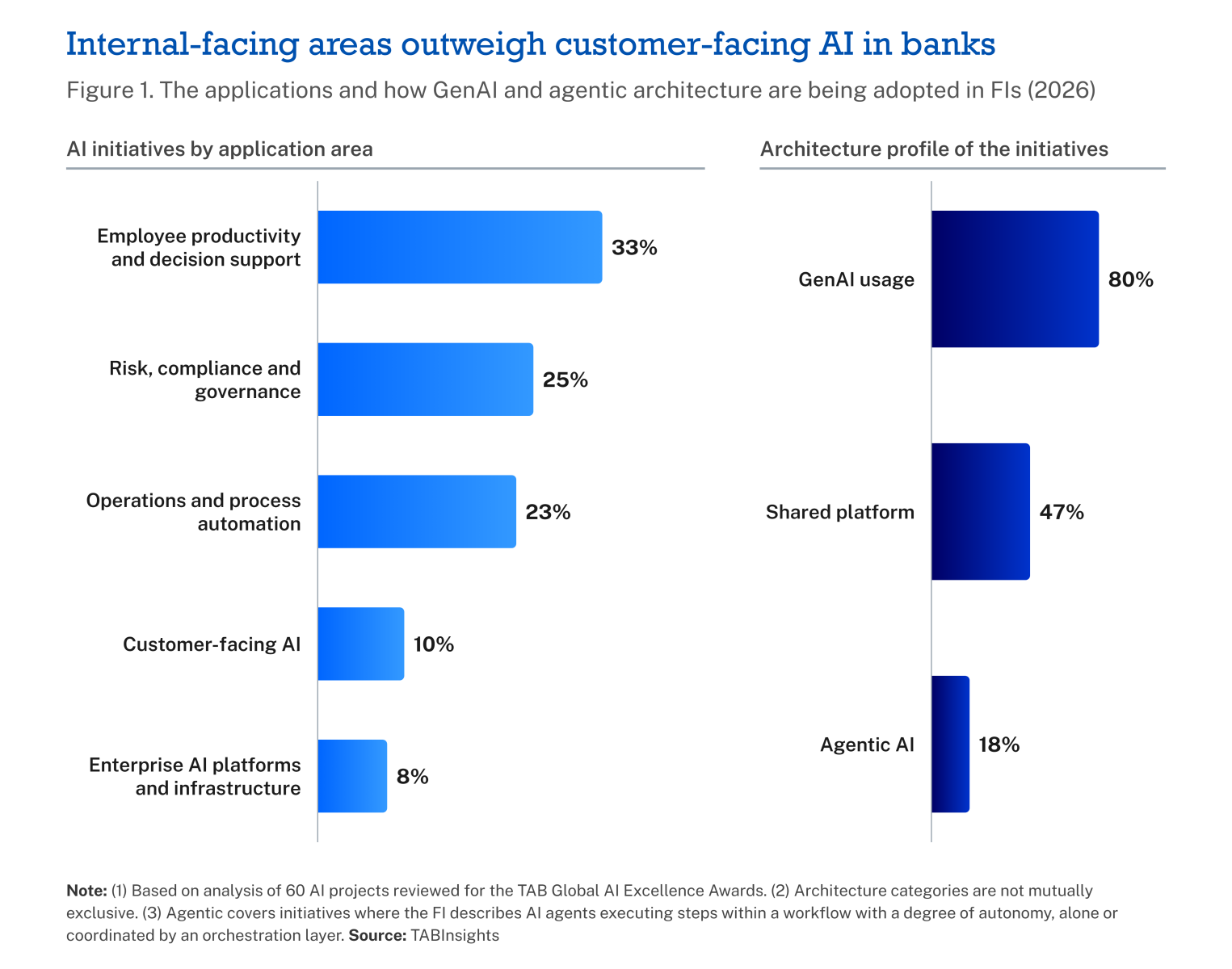
Generative artificial intelligence (GenAI) is now standard across banks and financial institutions, appearing in 80% of the 60 initiatives analysed. However, only 47% run on shared, reusable infrastructure, highlighting a gap between adopting AI and building the capabilities to scale it across an organisation.
The review covers initiatives implemented in 2025 or early 2026, drawn from The Asian Banker’s 2026 AI Excellence Awards programmes and interviews with selected leading banks, digital banks and financial platforms across Asia Pacific, the Middle East, Africa, Europe and Latin America. The findings suggest that access to AI models is no longer the main differentiator. Banks that can deploy AI repeatedly through shared platforms with governance built in are better positioned to scale faster beyond isolated pilots.
Agentic AI, in which systems execute steps with some autonomy rather than simply responding to a prompt, remains at an early stage, accounting for 18% of initiatives. However, nine of the 11 agentic AI initiatives run on shared infrastructure, pointing to the role of reusable platforms in supporting more advanced applications. While these capabilities are advancing, the clearest gains so far remain in efficiency, with limited evidence of revenue impact.
Shared platforms emerge as the differentiator
Leading banks are moving from one-off use cases to an enterprise-wide AI capability. They build shared foundations once and reuse them: common model hubs, knowledge bases, retrieval layers, gateways and guardrails that new applications plug into. These foundations also provide governed access to data and embedded controls.
Banks with reusable shared components report faster time to market, lower infrastructure costs and less engineering effort. The more mature banks manage their models centrally, with automated validation, drift monitoring and audit trails built into the machine learning operations (MLOps) pipeline. Some are also model-agnostic, using gateways and hubs to choose between proprietary, third-party and open-source models.
WeBank, for instance, runs a unified AI engineering platform that manages the full lifecycle, from data processing and model training to deployment and monitoring, enabling faster replication and scaling of AI applications across functions.
AI is applied to structured internal work first
Over 80% of the AI initiatives by application reviewed are concentrated in internal process: employee productivity and decision support, operations, and risk and compliance, while only about 10% are directly customer-facing. Banks are applying AI first to structured, repeatable processes, where gains are measurable and risks are easier to contain. The initiatives largely focus on speeding up existing processes rather than redesigning them.
GenAI copilots and knowledge assistants dominate employee productivity, cutting hours or days of information gathering to minutes. Kasikornbank, for instance, integrated copilot and GenAI tools with structured training, governance and workforce enablement across 22 divisions, leading to measurable productivity gains.
Automation initiatives run deepest in operations, such as reconciliation, document processing and application handling. AI can prepare much of the groundwork, from credit memos and research to case triage, leaving people to focus on judgement and the final call. The tasks often combine high volumes, defined steps and an output that a person can check. OCBC, for instance, automated credit application workflows and improved productivity through advanced document processing and information synthesis. Atmaal (Al Rajhi Bank) transformed underwriting, credit scoring and risk management by integrating intelligent data extraction, rule-based validation and AI-driven assessment.
In risk, AI applications concentrate on fraud, anti-money laundering, credit and compliance monitoring, where transaction volumes are growing and attacks are increasingly sophisticated. Banks often use hybrid designs. In several banks, classical machine learning models, suited to scoring high volumes of structured data and easier to validate, make the risk decision, while GenAI explains the results and supports investigations.
Customer-facing AI is mainly personalisation, conversational banking and wealth advice. The pattern points to an 'inside first, customers later' approach: banks are building confidence and controls internally before exposing AI externally, where the risks are higher. Even so, internal AI helps shape the customers experience, from faster credit decisions to quicker account opening.
The evidence is strong on efficiency and thin on revenue
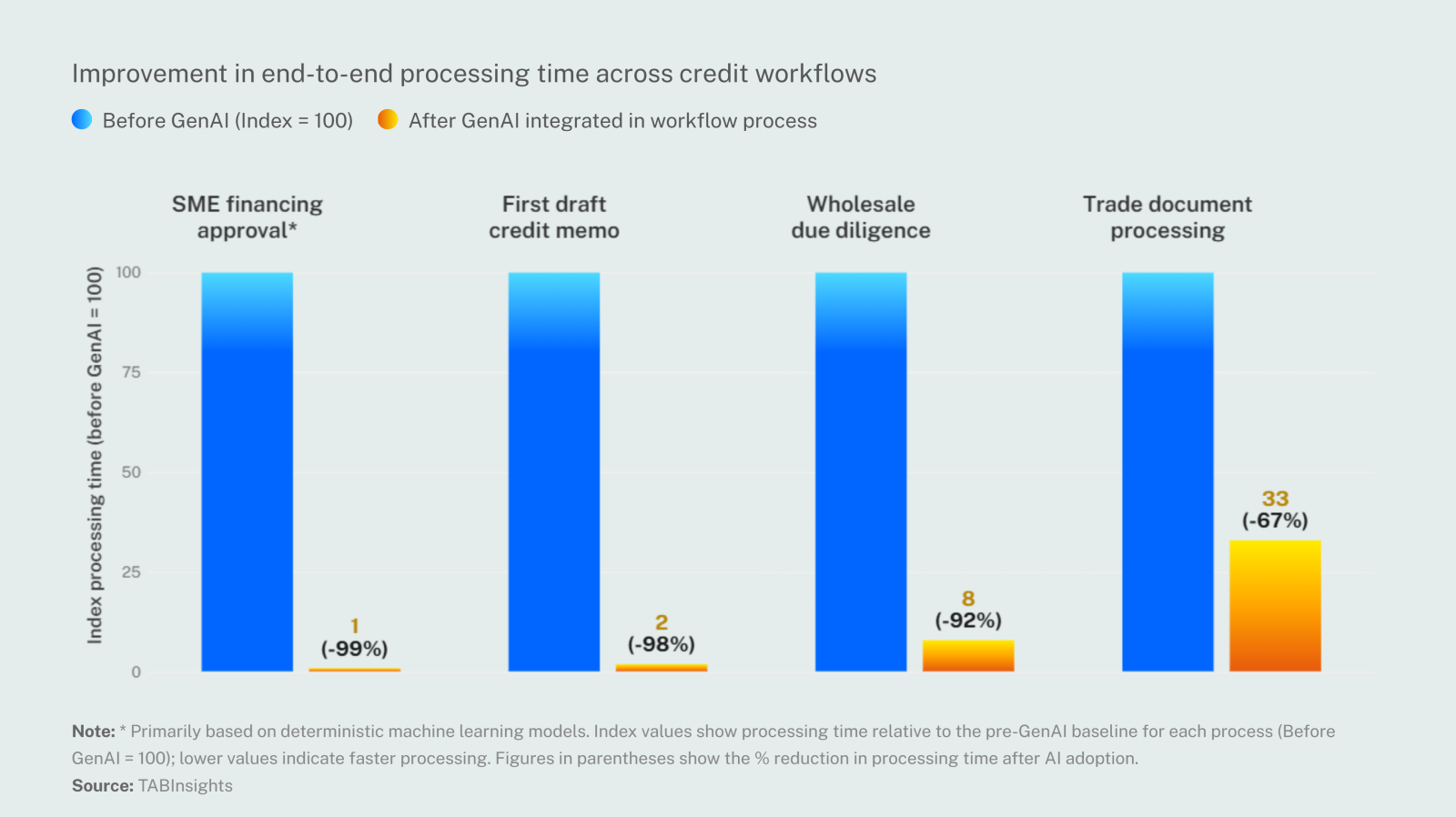
Reported outcomes centre on speed, lower manual effort and time savings. The gains are largest where AI drafts credit memos and analysis reports, with six of seven such initiatives reporting savings of more than 90%. In reconciliation, application handling and case processing, most report time savings from 80% to 95%.
Automation targets routine work: some institutions handle between 80% and 92% of routine cases automatically, from bond trades and loan applications to document processing. Larger, non-standard and higher-risk cases often still go to people.
The evidence for revenue is far weaker. Fewer than one in five initiatives quantify revenue impact, usually for a single product or business line, and some of those figures are projections rather than realised results.
From generating outputs to executing work
The frontier is now shifting from generation to execution. Agents are emerging where processes are clearly defined but each step needs judgement, such as software development, reconciliation, financing document checks and credit analysis. In more advanced systems, a task is split across specialised agents and an orchestration agent reconciles their outputs.
The shift also changes the risk. Once AI can access data, use tools and act across systems, each autonomous step moves a decision further from human sight, making it harder to trace how an outcome was reached unless every action is logged. Emerging guidance, such as Singapore's governance framework for agentic AI, recommends containing this by design: give agents access only to the tools and data they need, require human approval before high-stakes or irreversible actions and keep the deploying organisation accountable for what its agents do.
Governance built into the design and calibrated to risk
Familiar model risks remain, from hallucination and bias to model drift and data leakage. Regulators highlight the concentration risk arising from dependence on a small number of external providers of foundation models, cloud and computing capacity.
Leading banks are building guardrails into the platforms, so governance sits within the architecture rather than on top of it. Many ground GenAI in their own data through retrieval-augmented generation (RAG) to curb hallucinations, and build in explainability through reasoning trails for investigators, generated explanations alongside risk scores and auditable decision logs. Controls are moving into development: lower-risk applications get room for rapid experimentation, while higher-risk ones face more rigorous review. As autonomy grows, the controls that matter are specific: restricted access to systems and data, escalation thresholds, and continuous monitoring.
Where oversight is described, people remain in control. However, at machine speed, human supervision cannot mean reviewing every decision. Oversight is shifting to a risk-based model: people approve high-stakes decisions, set and oversee limits for routine ones and act on what automated monitoring flags. Where the final decision sits depends on the stakes.
Regulation is also stressing oversight and control. From December 2027, the EU AI Act will require high-risk systems, including credit scoring of individuals, to be designed so that people can override them or halt them with a ‘stop’ mechanism. The Reserve Bank of India’s draft model risk guidance proposes continuous monitoring, human oversight and kill-switch arrangements for AI models.
Data, controls and the operating model: the path to scale
Data comes first: moving from fragmented sources to integrated, governed data, on scalable cloud infrastructure with secure, high-speed computing capacity. Standard Chartered, for instance, is integrating data from about 150 disconnected systems and strengthening data governance, with 80% of its key data controls codified and 90% continuously monitored through automated AI guardrails.
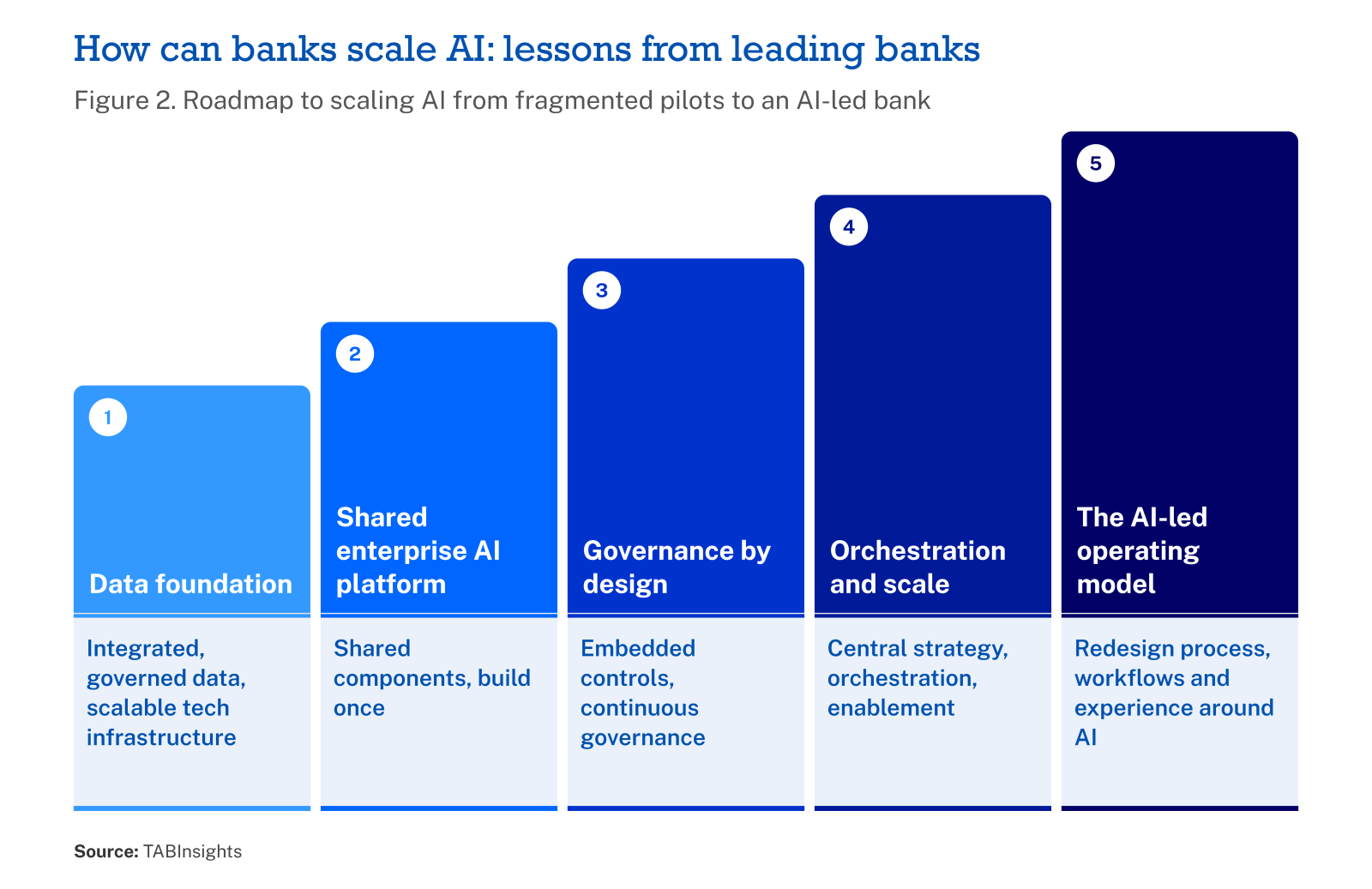
A reusable enterprise platform should sit on top, with shared components for agents, retrieval and document processing. Leading banks are industrialising the model lifecycle through sandbox testing, continuous integration and delivery, and shared model catalogues.
Governance by design embeds risk-tiered checkpoints and continuous monitoring in that platform. Orchestration and scale follow, with use cases prioritised centrally by value and reuse, and multi-agent workflows run on shared platforms.
Leading banks aim at an AI-led operating model, in which AI executes within limits, people set goals and oversee by risk, and processes are redesigned around it. Shared business and technology squads execute, while investment in talent and staff enablement helps the organisation to scale AI adoption.
The lesson is to treat AI as a factory: build the right data foundation, invest in shared platforms first, and measure reuse as closely as return on investment.
AI capabilities are advancing at a rapid pace. The banks that pull ahead will be those that can innovate and scale quickly: incorporate AI into their operating model, redesign processes around it, build employee capabilities, develop talent and embed governance. Today AI delivers efficiency. The challenge is to turn these productivity gains into measurable revenue growth.
Subscribe for regular insights.


Banner.png)



.png)






 Google
  LinkedIn