



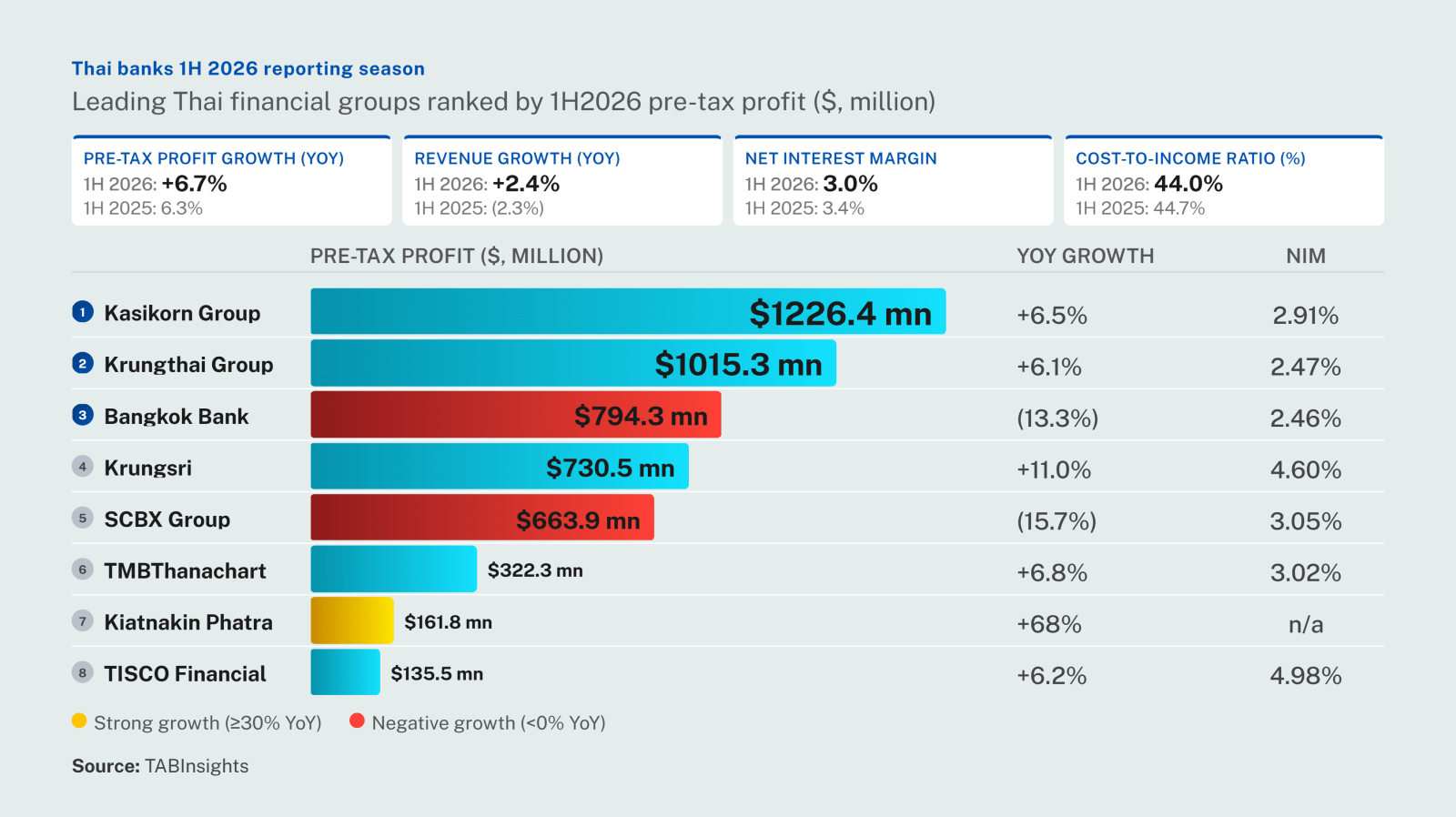

Thai financial institutions navigated the first half of 2026 (1H2026) against a backdrop of a 1.00% policy rate, a patchy economic recovery, weak household spending and an uncertain tourism outlook. With credit demand subdued and household leverage remaining high, banks prioritised profitability, margin preservation and asset quality over loan growth. They redirected capital towards better-priced corporate and secured lending, while funding franchises became increasingly important as banks repriced deposits and protected low-cost current account savings account (CASA) balances. Revenue diversification also gained prominence, with fee income driven by wealth management, insurance and payments. Digital priorities also shifted from customer acquisition towards monetisation, fraud prevention and operational resilience. As a result, competition increasingly focused on sustaining returns through disciplined pricing and underwriting rather than pursuing balance-sheet expansion.
Six of Thailand's eight leading financial groups reported higher pre-tax profit in 1H2026 than a year earlier, but declines at Siam Commercial Bank and Bangkok Bank offset most of those gains
Balance-sheet sensitivity to lower interest rates remained the key differentiator. Median net interest margin (NIM) narrowed from 3.36% to 3.02%, but a modest improvement in gross non-performing (NPL) ratios and stronger cost efficiency showed that banks largely contained credit and operating risks despite margin pressure.
Overall commercial-bank lending grew by approximately 1% year-on-year (YoY) in 1H2026, reflecting banks' continued preference for selective corporate lending over broad-based credit expansion. Large corporates drove most of the growth, supported by investment, export-related activity, technology supply chains, infrastructure and strategic industries. Government lending underpinned Krungthai's performance, while Bangkok Bank and Krungsri benefited from stronger international and ASEAN lending.
Retail credit remained subdued as banks prioritised higher-yield products for stronger borrowers, including credit cards, personal loans, home-equity products and wealth-linked lending. In contrast, mass-market consumer, auto and hire-purchase portfolios generally contracted. Lending to small and medium-sized enterprises (SME) also remained weak across most banks, reflecting subdued domestic demand, elevated operating costs, cautious underwriting and ongoing deleveraging. Revenue grew a modest 2.4% YoY in 1H2026, supported primarily by wealth management, insurance, capital markets and other fee-based businesses rather than broad credit expansion. These non-interest income streams helped partly offset the widespread margin compression caused by policy-rate cuts.
With loan demand subdued, earnings quality increasingly depended on effective liability management and the depth of fee income generation. Krungsri stood out by improving profitability through a strategic shift in business mix rather than broad-based domestic loan growth. The consolidation of TIDLOR and expansion of higher-yielding ASEAN and corporate portfolios lifted average loan yields from 6.9% in 1H2025 to 7.2% in 1H2026. At the same time, aggressive deposit repricing and funding-mix optimisation reduced funding costs from 1.75% to 1.3%. The bank deliberately reduced higher-cost term deposits while maintaining growth in lower-cost CASA balances, resulting in a 2.8% year-to-date decline in total deposits as it strengthened its funding profile.
TISCO remained the sector's highest-return franchise, with a 4.98% NIM and a 16.3% return on average equity (ROAE), while increasing pre-tax profit by 6.2%. Kiatnakin Phatra (KKB) recorded the fastest profit growth at 67.7%, driven by a low comparison base and improving asset quality. However, its performance reflected a recovery from weaker prior-year results rather than a sector-leading ability to navigate the lower-rate environment.
SCBX Group, the parent company of Siam Commercial Bank, and Bangkok Bank accounted for most of the drag on industry profit, with their earnings declines offsetting much of the gains recorded by other banks. SCBX's pre-tax profit fell 15.7% to THB 21.3 billion ($664 million) as its NIM contracted by 57 basis points. Bangkok Bank's pre-tax profit declined 13.3% to THB 25.5 billion ($794 million), reflecting weaker revenue and a 39-basis point contraction in NIM. Asset quality remained broadly stable at both banks, underscoring that lower interest rates—not deteriorating credit quality—led to weaker earnings.
Despite a decline in revenue and NIM, Krungthai Group protected profitability by maintaining the sector's lowest cost-to-income ratio at 39%. Kasikorn Group balanced cautious retail underwriting with resilient corporate lending to deliver 6.5% profit growth, while TMBThanachart (ttb) continued to improve funding costs and reallocate capital towards higher-yielding segments. Together, these results demonstrate that cost discipline can mitigate near-term margin pressure, although durable outperformance will ultimately depend on recurring fee income and appropriately risk-priced growth.
The outlook for fiscal year 2026 remains one of low growth and margin stabilisation rather than a broad lending recovery. Industry credit growth is expected to remain subdued at 0% to 2%, while full-year NIM guidance of 2.75% to 3.20% suggests earnings will rely increasingly on deposit repricing and mid-to-high-single-digit growth in fee income. Credit costs are projected to remain elevated at 130 to 160 basis points, with several banks already near or above the upper end of that range. Against a backdrop of 1.9% to 2.0% gross domestic product growth and a policy rate expected to remain at 1.00% through year-end, the sector is likely to deliver only low-single-digit profit growth, driven by funding optimisation and fee income rather than balance-sheet expansion.
Subscribe for regular insights.



Banner.png)



.png)






 Google
  LinkedIn