




The Gulf Cooperation Council (GCC), which includes Saudi Arabia, UAE, Qatar, Oman, Kuwait and Bahrain, entered 2026 with some of the world’s most profitable and cost-efficient banks. According to TABInsight’s World’s 1000 Strongest Bank Ranking 2025, GCC banks’ return on average equity exceeded the global median by two and a half percentage points in 2024, while operating efficiency stood at 37% compared with 50% globally.
Gulf banks have also been growing top line revenue by a compounded growth rate of 12% between 2020 and 2024. This momentum continued into 2025, with cumulative revenue and pre-tax profit across 44 listed GCC banks increasing by 10.7% and 14.2%, respectively, in the first half of 2025 (1H2025).
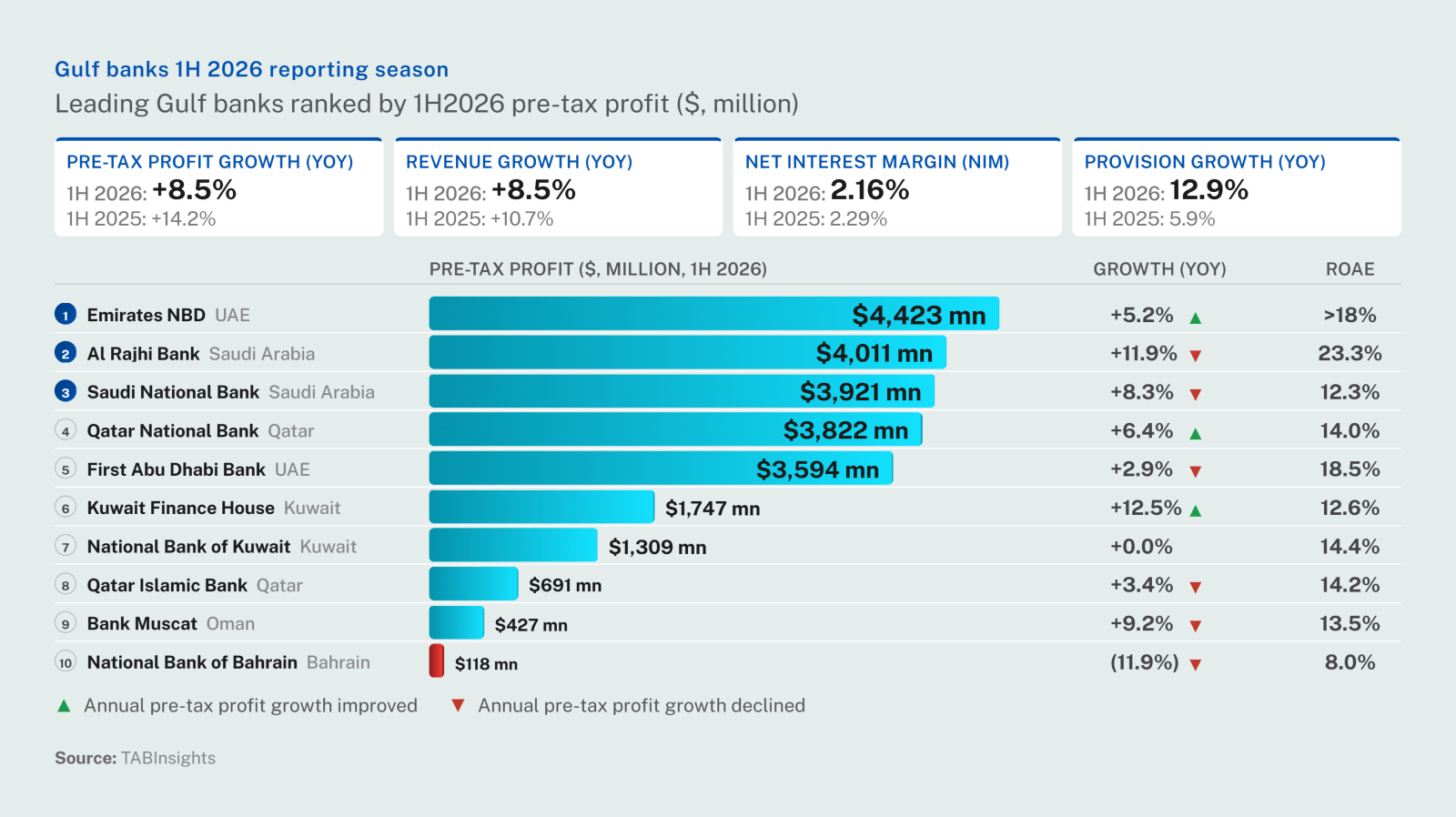
The slowdown in the first half of 2026 (1H2026) compared with 1H2025 marks a moderation from the strong income momentum seen between 2020 and 2025. Pre-tax profit growth slowed by over five percentage points to 8.5%, while revenue growth declined by 2.2 percentage points to 8.5%. The sector’s main weaknesses were slower operating momentum, margin pressure and higher provisions, rather than a broad deterioration in credit quality.
The clearest common concern for banks is the duration of regional geopolitical disruption and its possible knock-on effects, including delayed projects and trade, weaker credit demand, tighter funding conditions, margin pressure and borrower stress. Most banks raised the probability assigned to a worst-case macro-economic scenario for full-year 2026 to 30%.
This caution was reflected in additional provisioning and impairment charges, longer-term funding, tighter pricing discipline, more selective loan growth and, at some banks, deferred capital distributions. While banks generally emphasised that current asset quality remained resilient, their actions suggest that they are preparing for the risk that prolonged disruption could eventually affect liquidity, margins and credit quality. However, full year credit cost guidance for most banks remains below 2025 levels.
Combined provisions across the GCC sample increased by 12.9% year-on-year (YoY) in 1H2026, with 24 of the 44 banks increasing provisions. Emirates NBD recorded the largest increase, turning a net recovery of AED 300 million ($81.7 million) in 1H2025 into an impairment and provision charge of AED 1.4 billion ($381 million).
The average net interest margin across the GCC sample fell from 2.29% to 2.16%. The Middle East conflict was not the sole driver of the underlying slowdown, but it selectively intensified existing pressures. Seven of the 10 largest named banks in the GCC recorded slower YoY pre-tax profit growth than in 1H2025. Only Emirates NBD, Kuwait Finance House and Qatar National Bank reported an acceleration.
Four leading Gulf banks outperform peers in 1H2026
Emirates NBD was among the best-performing banks in the sample in 1H2026 despite narrower margins and higher provisions. Pre-tax profit growth improved from a 3% decline in 1H2025 to 5.2% growth in 1H2026. Its loan book expanded by 35% YoY, or about 28% excluding the newly acquired RBL Bank in India.
Growth was broad-based but led by corporate and institutional banking, where loans rose by 41%, compared with 21% in retail banking and wealth management. Its international business accounted for 31% to total loans.
Net interest revenue increased by 19% on strong lending, while wealth management, cards, foreign-exchange flows and structured products drove a 9% rise in non-interest revenue. Total revenue consequently grew by 16%, ahead of the 15% increase in expenses, enabling operating profit to rise by 17%. Kuwait Finance House’s (KFH) total profit growth accelerated to 12.5% in 1H2026 from 11.4% a year earlier, reflecting a broader, more diversified earnings base and disciplined execution across the group. Its international operations generated close to 60% of net profit and accounted for nearly 40% of group lending. Net interest income rose 6.9% despite margin compression as financing expanded and surplus liquidity was redeployed into financing and debt securities. Fee income increased 15.9%, while foreign-exchange income more than doubled, largely through Kuveyt Türk, its Islamic banking subsidiary in Turkey. Treasury recorded the strongest revenue growth, with operating income rising 178%. This was supported by higher foreign-exchange income, investment gains and the redeployment of surplus liquidity, although some of these gains were market-sensitive or non-recurring. Efficiency gains helped operating expenses fall 2.1% and the cost-to-income ratio improve to 30.6%.
Qatar National Bank’s (QNB) annual pre-tax profit growth accelerated from 5% in 1H2025 to 6.4% in 1H2026. Its loan book expanded by 8.3% year on year, driven mainly by corporate and international lending. For the Qatar market, corporate loans rose by 6.4%, while international loans increased by 15.5%; Revenue rose by 10% and net interest income increased by 1.4%, supported by balance-sheet growth and a stable margin. The core Qatar business continued to expand, while higher profit from Egypt helped offset weaker results in Turkey. The bank’s international business contributed 52% of total revenue and 34% of net profit. Like Emirates NBD and KFH, this combination of domestic strength and international diversification enabled QNB to increase pre-tax profit despite higher expenses and credit provisions.
Al Rajhi showed why a strong franchise did not guarantee accelerating earnings. Maintained high profitability, with its 23.3% return on equity (ROE) remaining the highest in the sample, while revenue rose by 14% on margin expansion of 36 basis points and strong fee growth. However, its loan book grew by only 2.7% year on year, reflecting moderate demand, securitisation and management’s focus on value over volume. Expenses increased by 15% as the bank invested in its Harmonize strategy and IT modernisation. Impairment charges rose by 34% following weaker Saudi economic assumptions, additional precautionary provisions and stress among selected non-giga-project corporates. These pressures reduced pre-tax profit growth from 33% in 1H2025 to 12% in 1H2026.
Loan growth and credit costs expose uneven demand and earnings quality
Median credit growth was 8.6% YoY across the 10 banks, but the range from 2.7% to 35% highlights the unevenness in demand. Acquisitions and accounting treatment also affected some headline figures. Emirates NBD’s loan book grew by 35%, or about 28% excluding its acquisition of India’s RBL Bank. Qatar Islamic Bank reported loan growth of 19.6%, although this included non-profit-bearing transactions linked to long-term deposits. Excluding these balances reduces growth to at least 12.8%. In Saudi Arabia, Al Rajhi and SNB recorded much weaker growth of 2.7% and 3.5%, respectively. Al Rajhi’s securitisation of mortgage and consumer loans reduced its reported loan book, while Saudi National Bank (SNB) prioritised returns over volume amid a softer lending pipeline. SNB, however, said project and SME demand was already improving, with related loan drawdowns expected to become more visible in 2H2026.Credit quality was not yet a common problem, although cost of credit varied sharply, ranging from a nine-basis-point net release at SNB, supported by cash recoveries, to a 74-basis-point charge at QNB. For 1H2026, Emirates NBD, Bank Muscat, Kuwait Finance House and Al Rajhi recorded net credit costs of approximately 42, 41 (calculated), 22 and 39 basis points, respectively. Emirates NBD’s charge was concentrated in DenizBank.
Conflict puts pressure on provisions and impairments
Larger and more diversified economies, including the UAE and Saudi Arabia, as well as countries such as Oman, which is less exposed to the Strait of Hormuz, are better placed to cushion the expected decline in gross domestic product (GDP) in full year 2026. For banks, the conflict’s main transmission channels have been higher provisions and impairment charges compared to 1H2025. In the UAE, FAB’s higher charges reduced pre-tax profit growth to 2.9%, compared with about 7.3% excluding the increase. In Qatar and Kuwait which are forecast to see the strongest economic contraction for full year 2026, corporate project awards, property and trade finance weakened. Qatar absorbed the shock mainly through liquidity, capital and borrower support. Qatar National Bank deferred instalments on QAR5.2 billion ($1.4 billion) of loans. Qatar Islamic Bank’s net impairment charge increased by 15.0% YoY but its annualised cost of credit declined to 39bp from 49bp, reflecting strong financing growth. Kuwait Finance House managed to grow its pre-tax profit by 12.5% despite a 113% rise in provisions and impairments. In Saudi Arabia, Saudi National Bank recorded an impairment charge increase by 131%, while Al Rajhi’s impairment charges rose by 34%, entirely driven by its non-retail banking segment.
Banks foresee different trajectories of recovery
Banks’ earnings calls pointed to four distinct trajectories for recovery should the conflict ease in the coming weeks. The UAE trajectory centres on origination. FAB expects infrastructure activity to begin at the end of the third or fourth quarter, while Emirates NBD's mid-teens lending target depends on corporate drawdowns and disrupted trade finance.
Qatar’s financial sector outlook is more tentative. QNB’s unchanged 5% to 7% profit and 6% to 8% balance-sheet growth guidance for 2026 assumes the conflict eases within three to four weeks and LNG output returns towards pre-war levels within six to eight weeks. Banks in Qatar remain liquid, but both are lengthening foreign funding and accepting some margin dilution to reduce refinancing and non-resident deposit risk. The common response is greater funding durability and risk-adjusted growth, rather than evidence of a GCC-wide liquidity shortage. Kuwait has the slowest trajectory. National Bank of Kuwait expects project execution to shift into late 2026 and 2027, leaving fees and recoveries to cushion delayed domestic growth. Saudi Arabia’s recovery is more selective as banks moderate growth or securitise assets in response to funding and return pressure.
The base case scenario is therefore a staggered recovery, but a delay into 2027 would put further pressure on loan and fee growth and could eventually lead to higher provisions or stage migration. These will be key indicators to watch in 2H2026. Strong capital, liquidity and coverage provide a buffer, but banks’ actions suggest that the second half will be the real test of their resilience and earnings quality.
View the World’s 1000 Strongest Bank Ranking 2025.


Banner.png)

.png)






 Google
  LinkedIn